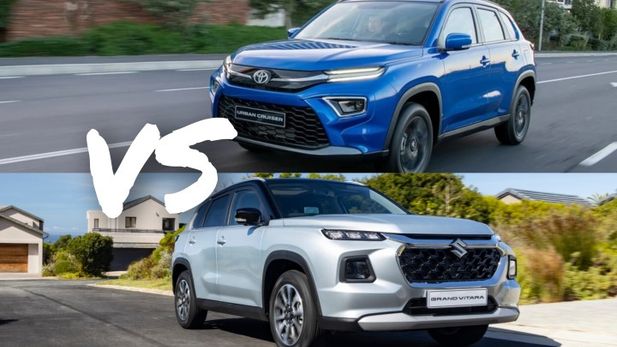
Hot on the heels of the local arrival of the new Suzuki Grand Vitara, Toyota SA has launched that model’s cousin – the new Urban Cruiser. What’s the difference between these budget crossovers and which one of them should you most consider buying?
The small crossover/compact SUV segment is hugely popular in South Africa and it recently gained 2 new products in the forms of the new Suzuki Grand Vitara and the new Toyota Urban Cruiser .
The Urban Cruiser is based on the Grand Vitara, both of which are built in India (in their respective brand production facilities) as part of the Suzuki-Toyota global product share agreement, which has spawned products such as the Baleno and Starlet , Ertiga and Rumion, Celerio and Vitz and the outgoing Vitara Brezza and previous-gen Urban Cruiser .
However, as a consumer looking to buy either the new Urban Cruiser or Grand Vitara, you may wonder: “What are the differences between these products?” Well, this article intends to answer that question.
The main aim of this article is to help you, the consumer, make an informed buying decision. To help you do this, we will provide you with the need-to-know information and insight based on available vehicle information and our experience with the cars in question.
This article will cover key aspects including Exterior Styling, Engine Performance and Efficiency, Interior Features & Safety, Dimensions & Practicality and Pricing and Warranty details.
If, at the end of this article, you are still undecided as to what to buy, you are more than welcome to reach out to us for advice via Twitter , Facebook or Instagram . Our experienced test team will gladly assist you.
Toyota Urban Cruiser vs Suzuki Grand Vitara: What’s the Difference?
Exterior Styling
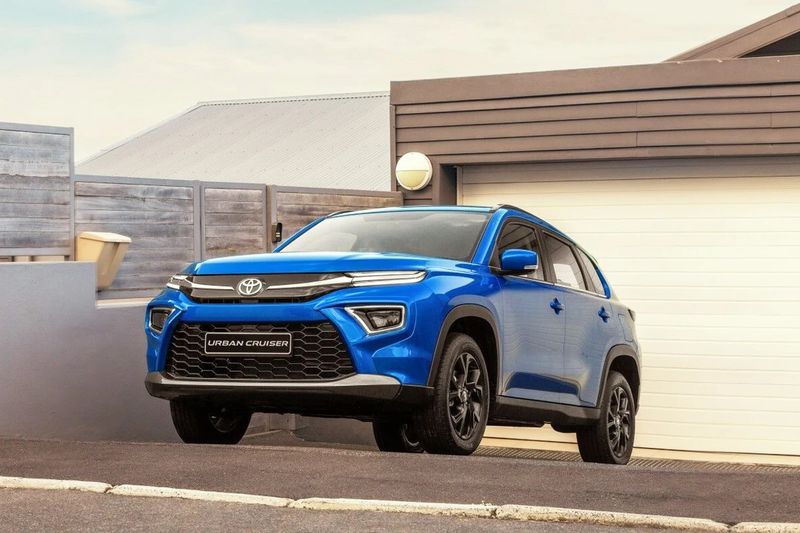
If you consider that the dimensions of the new Grand Vitara and Urban Cruiser are near-identical (see the dimension table below), their exterior appearances differ only in terms of minor cosmetic variations.
A side-by-side comparison highlights a clear difference in the grille and lower bumper design. The Urban Cruiser wears a larger lower grille section and uniquely styled fog lamp housings with chrome surrounds. Note the slim 2-tier LED Daytime Running Lights (DRLs) seen in the headlight units (not LED), as well as the gloss black / chrome combination used on the upper grille section.
Other notable features on the Toyota include black roof rails and black plastic cladding all around, the latter of which is also found on the new Grand Vitara.
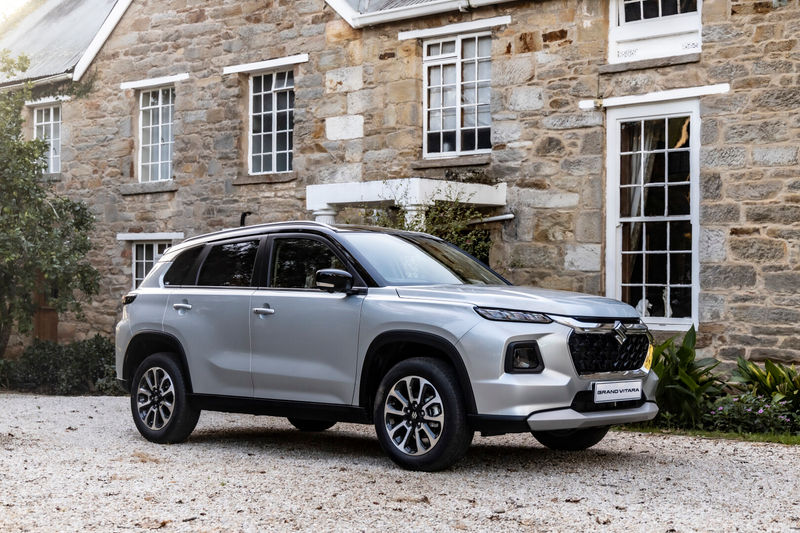
By comparison, the Grand Vitara’s bold grille is more centrally positioned and generously embellished with chrome trim. The slim LED headlights feature a 3-block DRL design and the foglamp housings have black surrounds. The Suzuki also features chrome roof rails and the rear end is defined by a wide taillight strip (but without the chrome wing that’s fitted to the Toyota). Both models ride on 17-inch wheels.
As styling is subjective, you can decide for yourself which of these cars has the better styling execution!
Engine Performance, Efficiency and Ride Quality
For the purpose of this comparison, we will compare the range-topping automatic derivatives from each model range (excluding the Grand Vitara’s flagship Grand 1.5 Hybrid GLX AllGrip derivative, which has an electrically-assisted engine). Note that 5-speed manual transmissions are available for both models.
Compare the Toyota Urban Cruiser 1.5 XR automatic with the Suzuki Grand Vitara 1.5 GL automatic
| Toyota Urban Cruiser | Suzuki Grand Vitara | |
| Powertrain | 1.5-litre petrol, NA | 1.5-litre petrol, NA |
| Power Output | 77 kW | 77 kW |
| Torque Output | 138 Nm | 138 Nm |
| Transmission | 4-speed automatic | 4 speed automatic |
| Fuel Consumption (claimed) | 6.1 L/100km | 6.0 L/100km |
Sadly, neither of these models delivers punchy performance. They share the same naturally-aspirated 1.5-litre 4-cylinder petrol engine that offers 77 kW of power and a middling torque output of 138 Nm.
From our experience with both cars, they lack outright punch (due to a lack of torque), which is to say that open-road overtaking ability is limited in the higher gears/at freeway speeds. As a result, drivers will have to plan their overtaking manoeuvres carefully, especially when the vehicles are fully loaded with occupants and baggage. It’s also worth mentioning that our test drives were conducted at sea level (the engines’ performance will be reduced by between 10 and 15% at higher altitudes, such as in Gauteng).
Nonetheless, both of these cars are perfectly suited for urban driving situations and most prospective buyers are likely to discover that the models perform their primary function, commuting, very well.
Despite the distinct lack of punch, the 4-speed automatic does a fair job of “swopping cogs” on behalf of the driver and, based on our initial experience in the Toyota Urban Cruiser, we found the automatic derivative to be marginally more fuel efficient than its manual counterpart. While you’re unlikely to see the claimed consumption of 6–6.1 L/100km, real-world returns of between 7.5-8 L/100km are feasible.
Riding on 17-wheels with high-profile rubber, both models offer good on-road manners with a comfortable and pliant ride quality expected for cars which will mostly be used in an urban setting. With a ground clearance of 210 mm, both the Grand Vitara and Urban Cruiser can also tackle the odd dirt road with some confidence.
Interior execution, features and safety
For this feature comparison, we are comparing the Toyota Urban Cruiser 1.5 XR automatic and the Suzuki Grand Vitara 1.5 GL automatic which are similarly priced and offer similar levels of standard specification.
You can, however, use our handy Cars.co.za Compare Tool to compare any vehicle derivative you like.
| Toyota Urban Cruiser 1.5 XR Auto | Suzuki Grand Vitara 1.5 GL Auto | |
| Infotainment System | 7-inch touchscreen | 7-inch touchscreen |
| Digital Instrument Cluster | No, analogue dials with TFT display | No, analogue dials with TFT display |
| Android Auto / Apple CarPlay | Yes, wireless | Yes, wireless |
| Bluetooth, Voice Control, USB, Wireless Charging | Yes, front USB port | Yes, front and rear USB ports |
| Rear View Camera | Yes | Yes |
| Steering adjustment: Rake / Reach | Both | Both |
| Cruise Control | Yes | Yes |
| Air Conditioning | Climate control | Climate control |
| Panoramic Sunroof | No | No |
| Upholstery / electric seats | Cloth, manual adjustment | Partial cloth /Artificial leather combination, manual adjustment |
| Front / Rear Park Distance Control | Rear | Rear |
| Safety Features | 6 airbags, ABS with EBD, brake assist, electronic stability control with traction control, hill assist control | 6 airbags, ABS with EBD, brake assist, electronic stability control with traction control, hill assist control |
The new Urban Cruiser and Grand Vitara share the same cabin architecture and the perceived build quality of both cabins can be considered fair… to quite good, considering the interiors of other models offered at this price point. Both vehicles’ cabins adequately suppress noise, vibration and harshness.
The interior materials used include a combination of hard, durable plastics and soft-touch surfaces and, while the interior execution can’t be described as luxurious, it’s certainly fit-for-purpose which is to say that the cabin construction is robust and should withstand the rigours of everyday family commuting.
As highlighted in the feature table above, the interior specifications for these 2 models are almost identical. However, the Suzuki pips the Urban Cruiser with additional features such as LED Projector headlights, a leather-wrapped steering wheel and a rear window wiper. The Suzuki Grand Vitara GL automatic is also R10k cheaper than the equivalent Toyota Urban Cruiser (see pricing and warranty table below).
Note that Suzuki offers a top-spec Grand Vitara GLX in manual and automatic guise which includes additional features such as a Head-Up-Display, 360-degree camera system, larger 9-inch infotainment system, panoramic sunroof, artificial leather upholstery and wireless charging.
Dimensions and Practicality
| Toyota Urban Cruiser | Suzuki Grand Vitara | |
| Length | 4 365 mm | 4 345 mm |
| Width | 1 795 mm | 1 795 mm |
| Height | 1 635 mm | 1 645 mm |
| Wheelbase | 2 600 mm | 2 600 mm |
| Ground Clearance | 210 mm | 210 mm |
| Rear Seating Configuration | 60:40 split | 60:40 split |
| Load Capacity (claimed) | 353 litres | 310 litres |
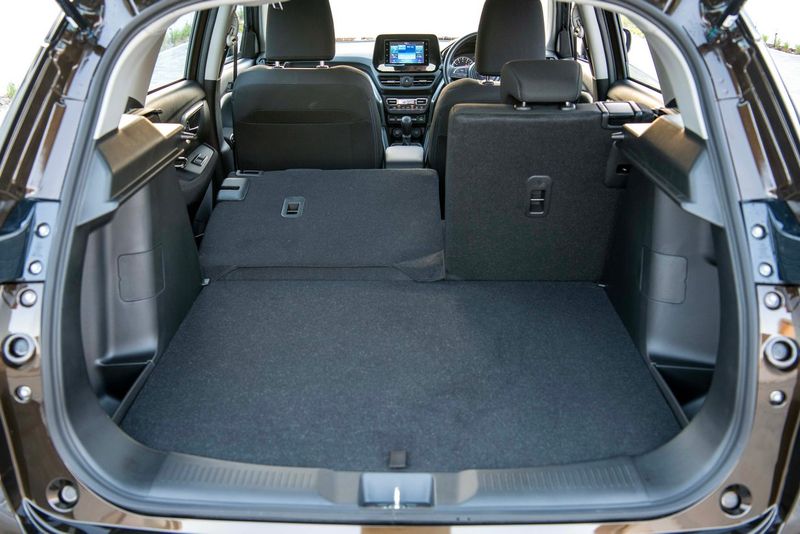
As indicated in the above table, the new Urban Cruiser and Grand Vitara are just about identical as far as dimensions are concerned. That 2 600-mm wheelbase is 100 mm longer than that of the outgoing Urban Cruiser/Vitara Brezza, which translates into improved rear occupant space, particularly in terms of leg- and knee room (yes, adults of average height can sit comfortably at the back). In addition to the rear armrest and 2 cupholders offered, the Grand Vitara has a rear USB port (but the Urban Cruiser doesn’t).
Both models have a 60:40-split rear seat configuration, but there appears to be an unusual discrepancy between the 2 crossovers’ claimed load-bay capacities. Toyota claims a larger load capacity (353 litres), which is some 25 litres larger than the outgoing Urban Cruiser, while the Grand Vitara is said to hold 310 litres. According to specs we got from a source in India (where the cars are built), both models’ load bays should be able to hold “373 litres”. We think it is likely that the brands’ local subsidiaries’ claimed figures are simply based on different measurement methods; both vehicles have full-sized spare wheels.
Pricing and Warranty
| Model | Price | Model | Price | |
| Entry | Toyota Urban Cruiser 1.5 XS Manual | R329 400 | ||
| Mid | Toyota Urban Cruiser 1.5 XR Manual Toyota Urban Cruiser 1.5 XR Automatic | R347 400 R369 900 | Suzuki Grand Vitara 1.5 GL Manual Suzuki Grand Vitara 1.5 GL Automatic | R339 900 R359 900 |
| Top | Suzuki Grand Vitara 1.5 GLX Manual | R397 900 | ||
| Suzuki Grand Vitara 1.5 GLX Automatic | R417 900 | |||
| Suzuki Grand Vitara 1.5 Hybrid GLX AllGrip | R529 900 | |||
| Vehicle Warranty | 3-year/100 000 km | 5-year/200 000km | ||
| Service Plan | 4 services/60 000 km | 6-year/90 000 km |
Toyota Urban Cruiser or Suzuki Grand Vitara: Which one should you buy?
As the various sections of this comparison show, the Toyota Urban Cruiser and Suzuki Grand Vitara are closely-related products that offer virtually identical performance – if underwhelming performance, due to the low torque of the non-turbo 1.5-litre engine. Nonetheless, very few would-be buyers will be much concerned with outright performance – budget crossovers are all about practicality and value for money.
Rest assured that either of these products will meet your basic family car needs with aplomb, but you will have to decide how important features such as a sunroof, wireless charging, surround-view camera, head-up display and larger infotainment screen are to you. The 1.5 GLX auto , which is the second-from-the-top Grand Vitara derivative, comes with all of those goodies, while the range-topping Urban Cruiser 1.5 XR auto doesn’t, but the latter costs significantly less (R48 000) than its Suzuki counterpart.
In this segment, a purchasing price of around R350k is likely to be the sweet spot for many buyers shopping for a small crossover/compact SUV and the Suzuki Grand Vitara 1.5 GL Automatic makes a compelling buying proposition with its keen pricing and superior standard specification over its Toyota-badged equivalent.
As has been proven in the past, badge appeal counts for a lot (the previous-gen Urban Cruiser eclipsed its Vitara Brezza cousin in terms of sales) and it will be interesting to see how well these products are received by the local market in the months to come. We suspect that, despite its more modest spec, the Urban Cruiser will again outsell the more generously equipped Grand Vitara, but only time will tell…
After-sales support is very important too (there are more than mere specification differences between the models). Bear in mind the Suzuki has a superior warranty (by 2 years/100 000 km) and service plan (by 2 years/30 000 km) than the Toyota. How long you intend on keeping your new purchase, combined with your personal feature preferences and budget, will determine which brand will get your business.
We hope that this article has clarified the differences between the new Toyota Urban Cruiser and Suzuki Grand Vitara. If you seek further advice, please feel free to reach out to us and we will gladly assist you.
Our Car Finance Calculator and Car Affordability Calculator are useful tools to help you make a sound car-buying decision and we encourage you to use them!